By Vaishnavee, Educationist & Founder, Eravoo Centre of Learning, Jayanagar, Bangalore
If you are the parent of a child between 2 and 6 years old, you have probably asked yourself some version of this question: am I doing enough?
You read the books. You name feelings. You make space for big emotions. You chose a preschool carefully — one that talks about play-based learning, emotional development, child-led discovery.
And yet something feels like it is not quite adding up.
The Paradox No One Is Talking About
We are raising the most emotionally aware generation of children in history. And according to global data, we are also raising one of the most anxious ones. Global anxiety disorders in children aged 10–14 have risen by 52% since 1990 (Frontiers in Psychiatry, 2024). In India, anxiety and depression now account for nearly 43% of all adolescent mental health cases (UNICEF India). Emotional dysregulation is showing up in kindergarten and primary classrooms at rates teachers say they have never seen before.
These are not children from difficult homes. These are well-loved, well supported children in good schools — children whose parents are doing everything right. Something else is happening.
The Skill We Forgot to Teach
Here is what I have come to believe, after years of working with children across every age group:
Emotional intelligence and resilience are not the same skill.
Emotional intelligence is the ability to name, understand, and communicate feelings. We taught this beautifully. Our children have emotional vocabulary that previous generations simply did not have.
Resilience is something different. It is the ability to survive discomfort — to sit with a hard feeling, stay present with disappointment, and keep going anyway. It is the ability to face something that does not go your way and not fall apart.
We built emotional intelligence. We forgot to build resilience. And now we are seeing the gap.
Why Ages 2–6 Are the Most Important Window
Research in developmental psychology consistently shows that emotional regulation — the ability to manage and recover from difficult feelings — is primarily built in the early childhood years, between ages 2 and 6 (ScienceDirect, School Mental Health Journal, 2024).
This is the window. Not secondary school. Not even primary school. Right now — in the preschool years — is when the foundation is laid.
A child who is protected from every difficulty in these years does not arrive at school resilient. They arrive fragile — because they have never had the chance to discover that discomfort is survivable. The small, unglamorous moments we keep rushing past — the puzzle that won’t come together, the friend who says no, the turn they have to wait for — these are not interruptions to development. They are the development.
This Is Not About Being Harder on Your Child
Before you read this as a criticism of warm, attentive parenting — it is not. The intention behind keeping children comfortable was always love. And the emotional vocabulary we have given this generation is genuinely precious.
What this is about is adding the missing half. Warmth and limits are not opposites. A child can be deeply heard and still be held to a boundary. A parent can be fully present and still let a child sit with a hard feeling rather than rushing to remove it. Both — not one at the cost of the other.
Three Things You Can Do This Week
1. Pause before fixing. When your child says “I can’t do this,” resist the urge to step in immediately. Sit with them. Say: “I know this is hard. Let’s stay with it a little longer.” That pause — that 60 seconds of staying — builds more than any solution.
2. Let disappointment land. If your child didn’t get what they wanted — don’t rush to replace the feeling with a distraction or a consolation prize. Name it with them: “That felt really disappointing, didn’t it?” Then let it be. A child who learns to sit with disappointment at 4 is far more equipped to handle it at 14.
3. Say no — and hold it. A boundary that moves every time a child cries teaches them that distress is a tool. Say no warmly, acknowledge the feeling, and hold the limit. Not harshly — but firmly. Both at once.
What We Are Building at Eravoo
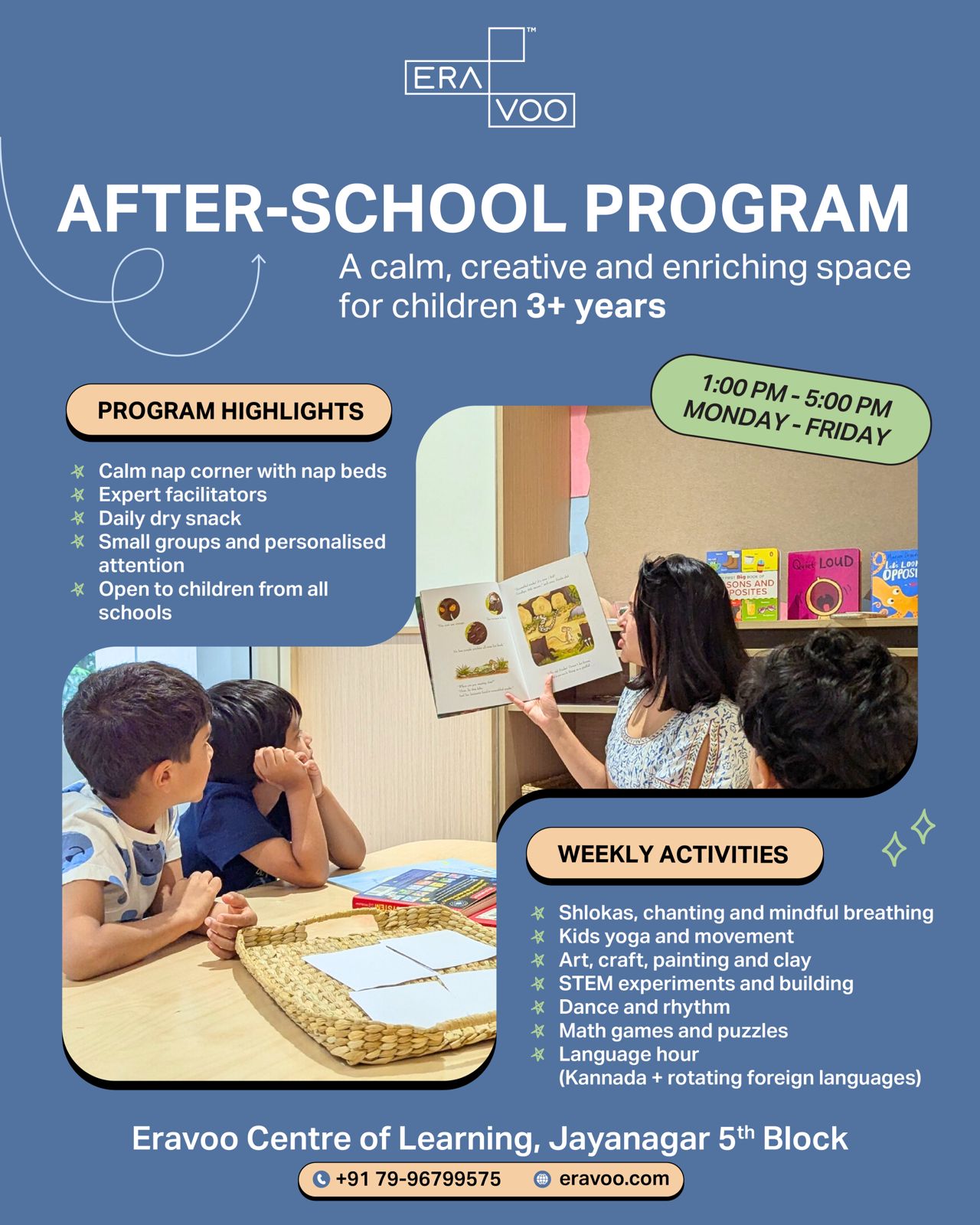
At Eravoo Centre of Learning, our nature-based preschool in Jayanagar, Bangalore, we work with children aged 2 to 6. Every day, we make choices about what to let children struggle with, what to let them feel, and when to step in — and when to stay close but let them find their own way.
We are not building the most academically advanced preschoolers in Bangalore. We are building children who know themselves, trust themselves, and can sit with hard things — because they have done it, in small, safe, supported ways, again and again. That, we believe, is the foundation everything else is built on.
Eravoo Centre of Learning
Nature-based preschool · Jayanagar 5th Block, Bangalore ·Ages 2–6
Book a Discovery Session at eravoo.com

Follow Our Learning Adventures
Terms & Conditions:
The application fee is non-refundable Missed appointments can be rescheduled
Terms and conditions are subject to change
Privacy Policy
© 2025 Eravoo Centre of Learning

We’d love to show you around our space.

29, 5th Main, 43rd Cross Jayanagar 5th Block Bangalore – 560041

hello@eravoo.com